Hi All,
Please see below a draft CIP that Cumberland has been working on to adjust the Validator Reward caps. We welcome any feedback.
Canton Improvement Proposal: Adjust Validator Reward Caps
Abstract
As the network continues to grow, there is an increasing potential for the free rider problem to emerge with Validators and liveness rewards; Validators can collect liveness rewards significantly in excess of their operating costs without
otherwise participating in the network.
To mitigate this and encourage participation among validators operating on the network, we suggest to adjust both the cap for Validator liveness rewards and activity rewards.
New values in the Canton Coin DSO configuration would be set as follows:
-
Validator Activity Reward Cap = 0.35
-
Validator Liveness Reward Cap = 4.5
Specification
Super Validator node operators will perform an on-chain vote to make the following changes.
For Activity Reward adjustment:
Change
issuanceCurve.futureValues.0._2.validatorRewardCap,
issuanceCurve.futureValues.1._2.validatorRewardCap,
issuanceCurve.futureValues.2._2.validatorRewardCap,
issuanceCurve.futureValues.3._2.validatorRewardCap
From 0.2
To 0.35
On DevNet, followed by TestNet and then MainNet.
For Liveness Reward adjustment:
Change
issuanceCurve.futureValues.0._2.optValidatorFaucetCap,
issuanceCurve.futureValues.1._2.optValidatorFaucetCap,
issuanceCurve.futureValues.2._2.optValidatorFaucetCap,
issuanceCurve.futureValues.3._2.optValidatorFaucetCap
From 570
To 4.5
On DevNet, followed by TestNet and then MainNet.
Motivation
CIP 0003 was initially raised to provide incentives to operate necessary infrastructure to interact with the network and offset the initial friction associated with engaging in activity on the network. As an initial set of users has onboarded
and the first use cases have gone live, the network should shift its incentive structure toward active participation.
Adjusting the Liveness and Activity Rewards caps allows the Super Validators to signal a change in these incentives and begin increasing the benefits for active participation. This, combined with new validators participating in the pro-rata
allocation of Liveness rewards will help to combat the free-rider problem while rewarding the most active participants.
Rationale
At current activity and onboarded Validator numbers (225), roughly 80% of Canton Coin (CC) minted from the Validator minting pool is associated with liveness reward. Each live validator earns roughly 709k CC/month in liveness rewards for
operating infrastructure that costs a fraction of that amount (at the current traffic conversion rate of $0.05) to operate. This creates an incentive for participants with no near-term plans to interact with the network to run a Validator and consume a Validator
slot that would otherwise be used by an active entity. While it is useful to prepare potential future participants in the early stages of network growth, it should be deemphasized over time.
To set new activity and liveness configurations, we evaluated four main criteria, assuming moderate activity growth:
-
Activity Rewards should be >50% of total validator mints
-
Liveness rewards should trend toward the cost of running a validator
-
No more than 10% of validator rewards should go un-minted
-
Validator Activity Reward cap cannot exceed 0.35
The share of the validator minting pool allocated to Activity Rewards relative to Liveness Rewards is agnostic of total validators on the network, because mints for Activity Rewards are allocated to parties prior to Liveness Rewards during
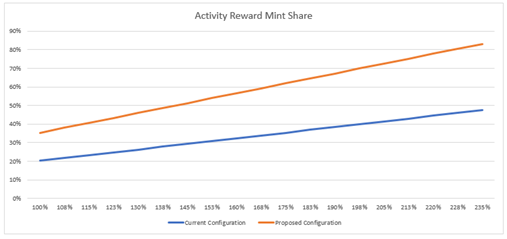
calculation of mints by the Super Validators. At current activity levels, the proposed configuration change will result in an increase of Activity Reward allocation from ~20% of the pool to ~35% of the pool. This increases significantly as network activity
grows as illustrated in the chart below, showing the relative allocation Activity Rewards for varying levels of network activity (measured relative to 7/10 transaction activity).

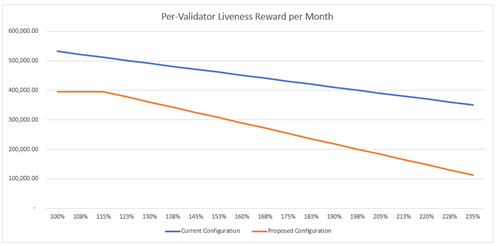
Assuming a population of 300 validators upon implementation of this CIP on-chain, Liveness rewards per Validator would be expected to decrease from approximately 532k CC to 394k CC. Although this reduction does not immediately resolve
the "free-rider" issue, it sends a clear message to network participants that liveness will be deemphasized moving forward. With a static number of onboarded validators, the rewards decrease rapidly as additional activity occurs under the new configuration,
eventually reaching around 190k CC at activity levels double those of today. This dilution accelerates significantly with the new configuration, as illustrated in the graph below, and further hastens when paired with an increase in the total number of onboarded
validators.

At current activity levels and 300 validators onboarded to the network, the proposed configuration would result in no more than 5.5% of the Validator minting pool going un-minted. Un-minted rewards are expected to decay to 0 at either
325 total Validators on the network or a 15% increase in total network activity (relative to measured 7/10 levels).
To maintain Sybil resistance of the network and protect against spam, each non-featured application actor on the network must receive fewer Canton Coin minting rights for transactions sent than cost of network fees (Canton Coin fees + Traffic
purchase cost) associated with that transaction. To enforce this, the Validator Activity cap and Unfeatured Application cap must together be less than 1. Given the current Unfeatured Application Activity cap is 0.6, this gives a ceiling value for the Validator
Activity cap of 0.4. To further disincentivize spam, we suggest a value of 0.35 to enforce a minimum cost for spam transactions at 5% of burn generated.
Backwards Compatibility
This CIP requires no new Daml models and no other breaking changes, so it will be fully backwards compatible.
This e-mail and any attachments may contain information that is confidential and proprietary and otherwise protected from disclosure. If you are not the intended recipient of this e-mail, do not read, duplicate or redistribute it by any means. Please immediately
delete it and any attachments and notify the sender that you have received it by mistake. Unintended recipients are prohibited from taking action on the basis of information in this e-mail or any attachments. The DRW Companies make no representations that
this e-mail or any attachments are free of computer viruses or other defects.